

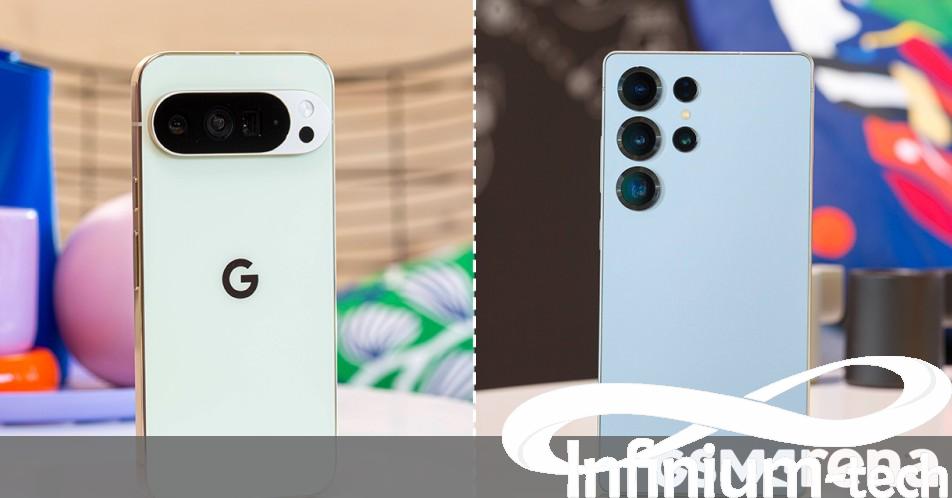
Google Pixel 10 Pro XL vs. Samsung Galaxy S25 Ultra | Infinium-tech
If you’re shopping for your next Android flagship, you’ll quickly narrow it down to two heavyweights: the Google Pixel 10 Pro XL or the Samsung Galaxy S25 Ultra. The Pixel offers a clean, stock Android experience and benefits from Google’s camera-first tuning. The Galaxy, meanwhile, brings veteran polish: a feature-rich One UI, full S Pen support, and an all-around balanced package.
Pixel remains a top choice for photographers and fans of pixel-perfect Android. Galaxy S25 Ultra argues its case as the do-everything flagship — ideal if you want power, versatility, and productivity in one device.
But it’s about time we settle this based on merits, or rather, based on our detailed review findings and declare a winner once and for all.
Table of Contents:
For starters, you can compare the complete spec sheets or directly continue with our editor’s assessment in the following text.
Size comparison
The Pixel 10 Pro XL and the Galaxy S25 Ultra measure almost identically. The S25 Ultra has a 0.1-inch larger screen, and the phone is also 1mm wider. The Pixel 10 Pro XL is 15 grams heavier, and you can feel the difference when you pick up those two in your hands.
The Pixel 10 Pro XL might be the newer device, but the Galaxy S25 Ultra has the more premium materials – it uses Gorilla Armor 2 on the front and has a titanium frame. The back panel remains Gorilla Victus 2 on both phones.
Both devices are IP68-rated without additional enhancements – they are dust and water resistant up to a depth of 1.5 m for 30 minutes.
As far as design goes, this is where things become subjective. The Galaxy has a cleaner design with five separate rings on the back, while the Pixel has a giant and thick camera island accommodating everything imaging-related.
Then there is the shape – the Pixel has more rounded corners, while the Galaxy has a more traditional rectangular shape with barely curved edges.
Finally, there are plenty of colorways to choose from for the S25 Ultra if we include the Samsung.com exclusives. But we think Google is offering enough for the Pixel, too, and we can’t imagine anyone picking either phone for the color.
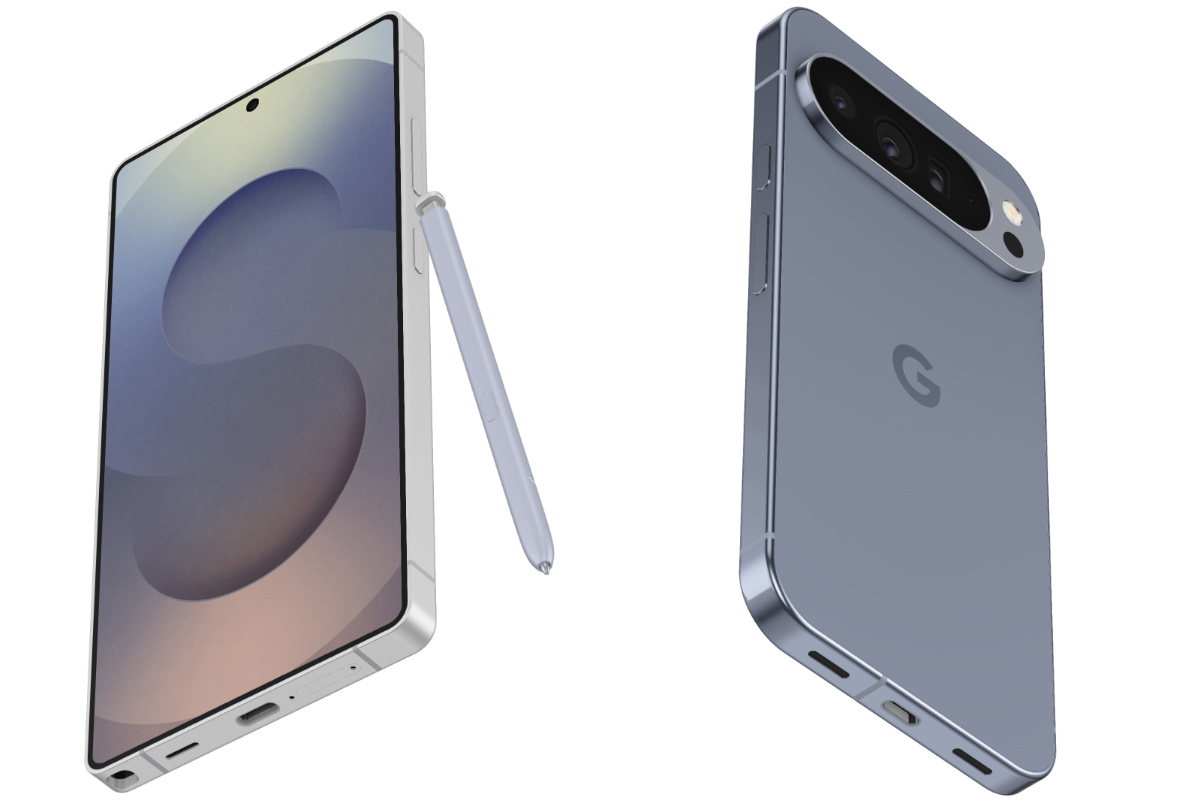
The Galaxy S25 Ultra is the tougher device with a more traditional build, a lighter one, too. And for that, it should be getting more points. But the Pixel’s camera bump might be worth the extra weight in the end, so let’s not jump to conclusions just yet.
Display comparison
Both the Pixel 10 Pro XL and the Galaxy S25 Ultra pack equally premium OLED screens. Sure, the Galaxy’s a whisker larger, but what probably matters most is its tougher Gorilla Armor 2 protection. Other than that, the two screens support a 120Hz refresh rate and HDR10+ streaming. And both have plenty of pixels.
The Pixel 10 Pro XL has the higher brightness of the two – 1366 nits in manual and 2,340 nits in automatic mode versus 784 nits and 1,417 nits for manual and automatic on the Galaxy. And considering how the S25 Ultra can’t even keep up its high brightness for too long, it may seem like an easy win for the Pixel. But you’d be wrong to dismiss the benefits of the Galaxy’s anti-reflective screen glass. Under bright light, it’s the Galaxy that’s easier to read.
Battery life
The Galaxy S25 Ultra may have a slightly smaller battery, but it has better battery life. It lasted much longer on the call and gaming tests, the same on video streaming, and it only trailed behind the Pixel on the web browsing scenario by 2 hours.
Overall, if battery life is really important, the Galaxy S25 Ultra will be the better pick of the two.
Charging speed
Both the Pixel 10 Pro XL and the Galaxy S25 Ultra support 45W fast wired charging via USB-PD with PPS-compatible chargers. Both Google and Samsung are selling such adapters.
The Galaxy S25 Ultra recharges noticeably faster, though. It got to 100% in 59 minutes, while it took the Pixel 10 Pro XL 82 minutes to do the same. Even in the lower percentages, the Galaxy is still recharging faster.
The Pixel 10 Series introduced a Qi2 wireless charging capability and has the needed magnets built right in, just like the iPhones. It’s compatible with MagSafe accessories, but Google has branded the feature Pixelsnap.
With a Pixelsnap Qi2 charger, the 10 Pro XL also gets a maximum of 25W wireless charging power, while the S25 Ultra can only take up to 15W, even though it technically supports Qi 2.1 wireless charging (and also lacks its own built-in magnets). So, all in all, that’s a win for the Pixel.
Speaker test
The Pixel 10 Pro XL and the Galaxy S25 Ultra employ a speaker setup of the hybrid stereo variety. There’s one bottom-firing unit and another one up top that’s facing forward and doubles as an earpiece.
Both setups scored a Very Good mark on our loudness tests. The audio quality is solid, too, but the Galaxy does sound somewhat better, with deeper and richer output.
Performance
The Pixel 10 series continues to use an in-house-designed chipset, only this year’s Tensor G5 is manufactured by TSMC on a 3nm fabrication process instead of Samsung’s 4nm. As is the norm, the company doesn’t brag too much about raw performance gains, but it has been mentioned that the new CPU is 34% faster than that in the Tensor G4.
The Galaxy S25 Ultra employs a 3nm Snapdragon 8 Elite chipset. It’s a “Snapdragon 8 Elite for Galaxy”, meaning the two prime CPU cores are clocked higher (4.47 GHz vs. 4.32 GHz), and the Adreno GPU runs at higher clock speeds.
Benchmark performance
The Tensor chips have never been chart toppers, and this applies to the new one, too. The Snapdragon scores a whole lot more than the Tensor inside the Pixel. And that’s why the Galaxy S25 Ultra gets an easy win here.
We just want to mention that the Pixel 10 Pro XL does behave like a flagship, handles apps and games smoothly, and you can see and feel that you are using a flagship phone. But as far as raw performance in the benchmark is concerned, it lagged behind by a large margin.
Camera comparison
The Pixel 10 Pro XL shares what is essentially the same camera system as the previous generation, with a somewhat hidden, but kind of meaningful, little upgrade. In principle, it’s a classic triple setup with the usual wide and ultrawide cameras and a single 5x zoom telephoto. And it’s on the telephoto where the one camera upgrade this year hides – it’s the minimum focusing distance, which is now 30cm, compared to the 73-75cm on the previous generation. So the two 5x cameras are matched in this respect.
- Wide (main): 50MP (1/1.31″, 1.2µm-2.4µm), f/1.68, 24mm, dual pixel PDAF (10cm – ∞), Laser AF, OIS; 4K@60fps/8K@30 (via cloud-based upscaling)
- Ultrawide: 48MP (1/2.55″, 0.7µm-1.4µm), f/1.7, 12mm, multi-directional PDAF; 4K@60fps
- Telephoto 5x: 48MP (1/2.55″, 0.7µm-1.4µm), f/2.8, 110mm, multi-directional PDAF (30cm – ∞), OIS; 4K@60fps/8K@30 (via cloud-based upscaling)
- Front camera: 42MP (0.7µm-1.4µm), f/2.2, 18mm, dual pixel PDAF; 4K@60fps
The Galaxy S25 Ultra doesn’t bring a whole lot of changes in the camera hardware either. The previous model didn’t either, and it’s not like the S23 Ultra was packed with exciting hardware upgrades compared to its own predecessor. The point is, the Galaxy Ultra camera is evolving just as steadily, but also quite slowly. But what it has more than the Pixel is a second telephoto camera for 3x zooming.
- Wide (main): 200MP Samsung ISOCELL HP2 (S5KHP2, 1/1.3″, 0.6µm-2.4µm), f/1.7, 23mm, multi-directional PDAF, OIS; 8K@30fps, 4K@120fps
- Ultrawide: 50MP Samsung ISOCELL JN3 (S5KJN3, 1/2.5″, 0.7µm-1.4µm), f/1.9, PDAF; 8K@30fps, 4K@120fps
- Telephoto 1, 3x: 12MP Sony IMX754 (1/3.52″, 1.12µm), 69mm, f/2.4, PDAF, OIS; 4K@60fps
- Telephoto 2, 5x: 50MP Sony IMX854 (1/2.52″, 0.7µm-1.4µm), 111mm, f/3.4, PDAF, OIS; 8K@30fps, 4K@60fps
- Front camera: 12MP Samsung ISOCELL 3LU (S5K3LU, 1/3.2″, 1.12µm), f/2.2, 26mm, dual pixel PDAF; 4K@60fps
Image quality
Daylight
The 12MP daylight photos coming from both flagships are great – that’s for sure. They have a similar level of detail and dynamic range, but they take different approaches to exposure metering – the Pixel always protects the highlights better. It also has the better corner sharpness of the two, but the Galaxy has the more accurate color rendition.








Daylight comparison, main camera (1x): Pixel 10 Pro XL • Galaxy S25 Ultra
Neither phone has 2x telephoto cameras, but they do offer 2x in-sensor zoom. The Galaxy makes good use of its 200MP sensor and saves more detailed photos, especially when it comes to foliage and texts. The Pixel’s photos still impress with dynamic range and color rendering, but you will notice the artificial detail rendering.








Daylight comparison, main camera (2x): Pixel 10 Pro XL • Galaxy S25 Ultra
The Galaxy S25 Ultra features a dedicated 12MP 3x telephoto camera with f/2.4 aperture, while the Pixel has to rely on 3x in-sensor zoom. However, we were quite surprised to see how well the Pixel could hold its own against the Galaxy’s optical zoom camera here. Especially indoors, the Pixel was somehow able to capture nicer photos than the Galaxy’s telephoto cam.








Daylight comparison, (3x): Pixel 10 Pro XL • Galaxy S25 Ultra
Both phones pack 5x telephoto cameras, and both deliver superb photos across the board. Here, the Galaxy S25 Ultra has an edge over the Pixel with wider dynamic range and a more natural rendition of grass and foliage. However, the level of resolved detail is generally the same. And indoors, the Galaxy’s darker aperture allows some noise to come through even in good light.








Daylight comparison, telephoto camera (5x): Pixel 10 Pro XL • Galaxy S25 Ultra
Finally, the 10x zoomed photos look good from both devices, but the Galaxy has a nicer rendition of the fine detail.








Daylight comparison, telephoto camera (10x): Pixel 10 Pro XL • Galaxy S25 Ultra
When shooting with the ultrawide, the two phones offer similar dynamic range but the Pixel has a tad sharper detail. The Galaxy has more natural colors though, and indoors, it is better in noise reduction and intricate detail.








Daylight comparison, ultrawide camera (0.5x): Pixel 10 Pro XL • Galaxy S25 Ultra
Selfies
The Pixel 10 Pro XL saves 10MP ultrawide-angle selfies, while the Galaxy S25 Ultra captures 12MP shots with a regular field-of-view. Both produce excellent selfies. However, along with a wider angle, the Pixel also has a wider dynamic range, and it provides the same level of detail rendition despite the fact that it fits more in the frame. So even if you crop a bit of its selfies, you’d still get the same level of quality as the Galaxy.








Daylight comparison, selfie camera: Pixel 10 Pro XL • Galaxy S25 Ultra
Low-light
Moving on to low-light shooting, the Pixel’s main cam does a better job here than the one on the S25 Ultra. It offers better detail, wider dynamic range, and more saturated colors.
Enabling the dedicated Night Mode on the S25 Ultra brings it closer to the Pixel’s output, but even then, it can’t quite match the Pixel’s rendition of detail.












Low-light comparison, main camera (1x): Pixel 10 Pro XL • Galaxy S25 Ultra • Galaxy S25 Ultra (Night Mode)
At night, the 2x zoomed photos are very good from both phones. Contrary to the daytime shots, the Pixel’s output is often more accurate when it comes to colors and intricate detail rendition.









Low-light comparison, main camera (2x): Pixel 10 Pro XL • Galaxy S25 Ultra • Galaxy S25 Ultra (Night Mode)
At 3 times zoom, the Pixel continues to surprise us with its great performance even after dark. Only with Night mode enabled does the Galaxy’s 3x zoom camera manage to match it.









Low-light comparison, (3x): Pixel 10 Pro XL • Galaxy S25 Ultra • Galaxy S25 Ultra (Night Mode)
The 5x telephoto cameras do a good job after dark on both phones. The Galaxy’s output is a bit noisier and slightly darker.
But with night mode on, the S25 Ultra’s 5x zoom saves cleaner and more detailed photos than the Pixel.












Low-light comparison, telephoto camera (5x): Pixel 10 Pro XL • Galaxy S25 Ultra • Galaxy S25 Ultra (Night Mode)
The 10x zoom option produces usable photos on both phones. Once again, when using Night Mode, the S25 Ultra offers a similarly good output to the Pixel 10 Pro XL, while without Night Mode, its photos are noisier.









Low-light comparison, telephoto camera (10x): Pixel 10 Pro XL • Galaxy S25 Ultra • Galaxy S25 Ultra (Night Mode)
Finally, let’s talk about the ultrawide cameras. The photos from both phones have roughly the same amount of resolved detail and produce likable shots. The Galaxy S25 Ultra’s images offer a wider dynamic range, but this advantage is barely noticeable. On the other hand, what you can spot immediately is the warmer color saturation that’s more realistic, and the slightly more natural rendition of, well, everything.












Low-light comparison, ultrawide camera (0.5x): Pixel 10 Pro XL • Galaxy S25 Ultra • Galaxy S25 Ultra (Night Mode)
At the end of this chapter, it’s clear that the two phones trade blows when it comes to camera performance. While the Galaxy S25 Ultra has more versatility in theory, the Pixel 10 Pro XL has a great 3x digital zoom which robs the Galaxy of its single hardware advantage. In the end, we’d say both phones provide equally good photo quality, unless of course, you are into ultra-wide group-style selfies (groupies?), in which case, the Pixel 10 Pro XL takes the cake (yes, they are that close).
Video quality
The two phones have wide-ranging video-recording capabilities, including 8K capture at 30fps on the primary camera, and 4K capture at either 60 or 30 fps with all of the cameras. The Galaxy’s primary camera also offers a 4K120 option.
Always-on electronic stabilization is available on all cameras across both phones, and it works excellently.
The Galaxy S25 Ultra is the better camcorder during broad daylight, especially when it comes to zooming. The Galaxy offers more detail and better rendition in 2x and 10x zoom; its native 3x and 5x are far better than the Pixel’s too.
The only time when the Pixel did better was when taking ultrawide videos – they came out more detailed and sharper.
Below we have a few framegrabs from the videos taken by the two phones at each focal length, so they are easier to compare to one another.






Daylight video samples, Pixel 10 Pro XL: 0.5x • 1x • 2x • 3x • 5x • 10X






Daylight video samples, Galaxy S25 Ultra: 0.5x • 1x • 2x • 3x • 5x • 10X
The Pixel’s ultrawide advantage did not carry over to the nighttime recording, unfortunately. The Pixel saves face with its main cam videos, but it’s all downhill from there. The Pixel won’t even switch to its telephoto camera for 5x and 10x levels, so you are essentially looking at its main camera at every scene from 1x and above.






Low-light video samples, Pixel 10 Pro XL: 0.5x • 1x • 2x • 3x • 5x • 10x






Low-light video samples, Galaxy S25 Ultra: 0.5x • 1x • 2x • 3x • 5x • 10x
The Galaxy S25 Ultra is simply more skilled than the Pixel 10 Pro XL when it comes to video capturing.
Verdict
The Pixel 10 Pro XL and the Galaxy S25 Ultra are excellent flagship devices. Getting either one will give you a buttery-smooth Android experience with lots of AI features. They both have some great speakers, and their camera skills are also top-notch, and it’s hard to pick a winner in image quality.
Pixel 10 Pro XL has a screen that can blast way higher than the Galaxy, and it has built-in magnets for MagSafe accessories and wireless charging. It did not score a decisive win in camera quality, but it has the wider-angle selfies, and it has a seriously competitive 3x digital zoom to the point we preferred it to the Galaxy’s optical zoom camera at times.
The Galaxy S25 Ultra, however, is lighter in weight while using more premium materials overall. We love its display’s anti-reflective glass, and it’s got better battery life with faster charging – not to mention, a lot more oomph under the hood. And while it did not stand out in image quality, its video quality was better.
So, Pixel 10 Pro XL or Galaxy S25 Ultra? Not an easy choice! But the Galaxy won more points in this comparison article, and at the time of writing, it’s even the cheaper phone of the two, so even though the Pixel has its merits, we’d say Samsung’s phone deserves our recommendation more and takes the win here.

- The brighter display.
- The built-in magnets for MagSafe accessories and wireless charging.
- The wider selfie camera, which is great for groupies.
- The really competitive 3x digital zoom mode, which takes away the Galaxy’s optical zoom advantage.
Get the Google Pixel 10 Pro XL for:
- The S-Pen stylus support.
- The more premium materials and the lighter weight.
- The anti-reflective screen glass.
- The more powerful chipset.
- The longer battery life.
- The faster charging.
- The better video quality.
- The lower price.
Get the Samsung Galaxy S25 Ultra for:










Leave a Reply