

Samsung details upcoming 2nm nodes, talks of future 1.4nm nodes (coming in 2029) | Infinium-tech
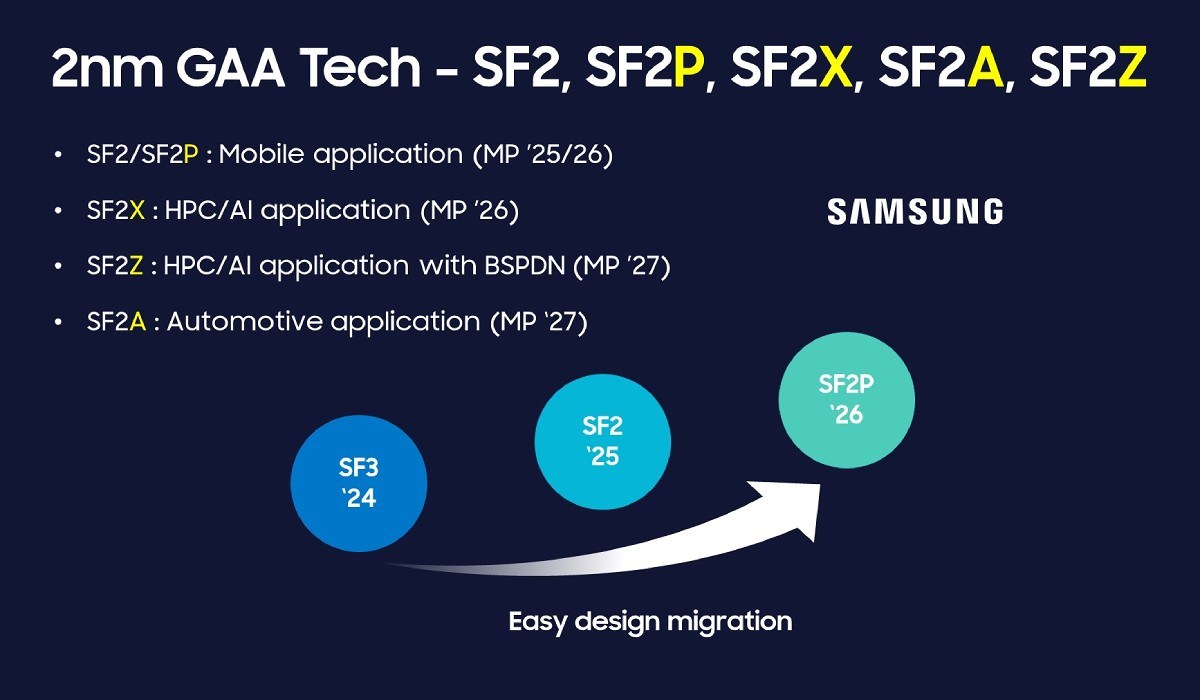
At the SAFE Forum (Samsung Advanced Foundry Ecosystem), Samsung revealed its plans for future semiconductor nodes. Last year, the company unveiled the Exynos 2600, the first 2nm smartphone chip – it was built on the SF2 node as Samsung calls it.
Next up is SF2P, which will reduce power consumption by 26% and increase clock speed by 15%. The new node is only partially responsible for these improvements. Shin Jong-shin, vice president of the design platform development team at Samsung Foundry, attributes more than half of the profit to DTCO.
DTCO, or design-technology co-optimization, is a chip-manufacturing approach that combines semiconductor manufacturing methodology and chip design – traditionally, these are two separate steps in building a new chip, but working on them together enables better optimized designs. This results in higher speed, lower power and even cost savings.
SF2P+ will come next – mass production is expected to begin between 2027 and 2028. There is also another node in the works, SF2X, but that will be optimized for AI hardware.
Samsung is also working on ways to pack more SRAM onto chips. SRAM is used to create the registers and caches of a CPU or GPU. This is much faster, but takes up more space than DRAM – to put things in perspective, a typical SRAM cell (which stores one bit, i.e. 0 or 1) requires 6 transistors, while a DRAM cell only needs 1 transistor.
The Nvidia Rubin GPU (built on TSMC’s N3 node) has 128MB of on-die SRAM. Samsung and Groke are working on an LLM accelerator that will have over 500 MB of SRAM and is on the older 4nm node. Samsung-backed Rebellion showed off the REBEL-100 AI accelerator, which is currently being produced on Samsung’s 4nm node.
After the 2nm era, Samsung will transition to 1.4nm nodes, starting with SF1.4, which is scheduled for mass production in 2029. This will be followed by SF1.4+ in 2030. SF1.4 was originally scheduled for 2027, but the timeline was pushed back a few years.














Leave a Reply